A Burnaby parkade coating peeled off in sheets fourteen months after it went down. The membrane was fine. The concrete was fine. What sat between them was eleven years of tire rubber, drip oil, and a thin film of old sealer that the prep crew had ground the high spots off and called done.
That job is the reason concrete surface preparation in Vancouver keeps landing on my phone as an emergency instead of a plan. Coatings almost never fail because the slab was weak. They fail because something was still on it.
The second reason the calls come in: shot blasting and grinding are getting harder to run in occupied buildings, and building managers are looking for methods that do not fill the space with dust.
Profile and cleanliness are two different problems
Contractors conflate them constantly, so it is worth separating.
Profile is texture. The ICRI scale runs CSP 1 through CSP 9, from acid-etch smoothness up to heavy scarified. A thin epoxy sealer wants CSP 1 to 3. A 6 mm urethane deck system wants CSP 4 or 5. A trowel-down industrial floor at a Delta food plant might want CSP 6.
Cleanliness is what is left in and on the pores after the texture is right. Oil that wicked 3 mm into the slab. Sugar and fat residue in a bakery. Biofilm on a clarifier wall at a wastewater plant. Salt from four winters of cars dripping brine onto a ramp.
Mechanical methods buy profile. They are mediocre at cleanliness, because a diamond grinder passing over an oil-soaked patch smears the oil and opens fresh pores for it to sink into. That is the failure mode behind the Burnaby parkade.
So the practical question is never "abrasive or not." It is: how much profile does the coating spec actually require, and what is the fastest way to get the slab clean enough that the coating bonds to concrete instead of to contamination.
Where the abrasive methods are losing ground in BC
Shot blasting still cuts profile faster and cheaper than anything else on open, empty slab. Nobody serious argues otherwise. The pressure is coming from everywhere around the machine.
Respirable crystalline silica is the big one. Concrete dust is loaded with it, and the WorkSafeBC exposure limit sits at 0.025 mg/m³ over an eight-hour shift, which is low enough that dry mechanical work on concrete needs a written exposure control plan, engineering controls, fit-tested respirators, and in many cases air monitoring. That paperwork and hardware is now a real line on the quote, not a formality.
Then there is everyone else in the building. A Richmond distribution centre cannot let silica dust drift into a racked food-grade area two bays over. A North Vancouver strata cannot have grinding noise and dust in an occupied parkade on a Tuesday. A Mount Pleasant restaurant on the floor above a mechanical room has no interest in the vibration.
Containment answers those objections and costs $1,500 to $3,000 per day in poly, negative air, and the labour to build and strip it. On a two-day cleaning scope, containment can outprice the cleaning.
Last, waste. Spent shot, slurry, and the removed coating leave the site as a waste stream that somebody weighs and disposes of. On a pre-1990 slab with an unknown coating, that stream gets sampled first, and the schedule stops until the lab reports.
What dry ice blasting does on concrete
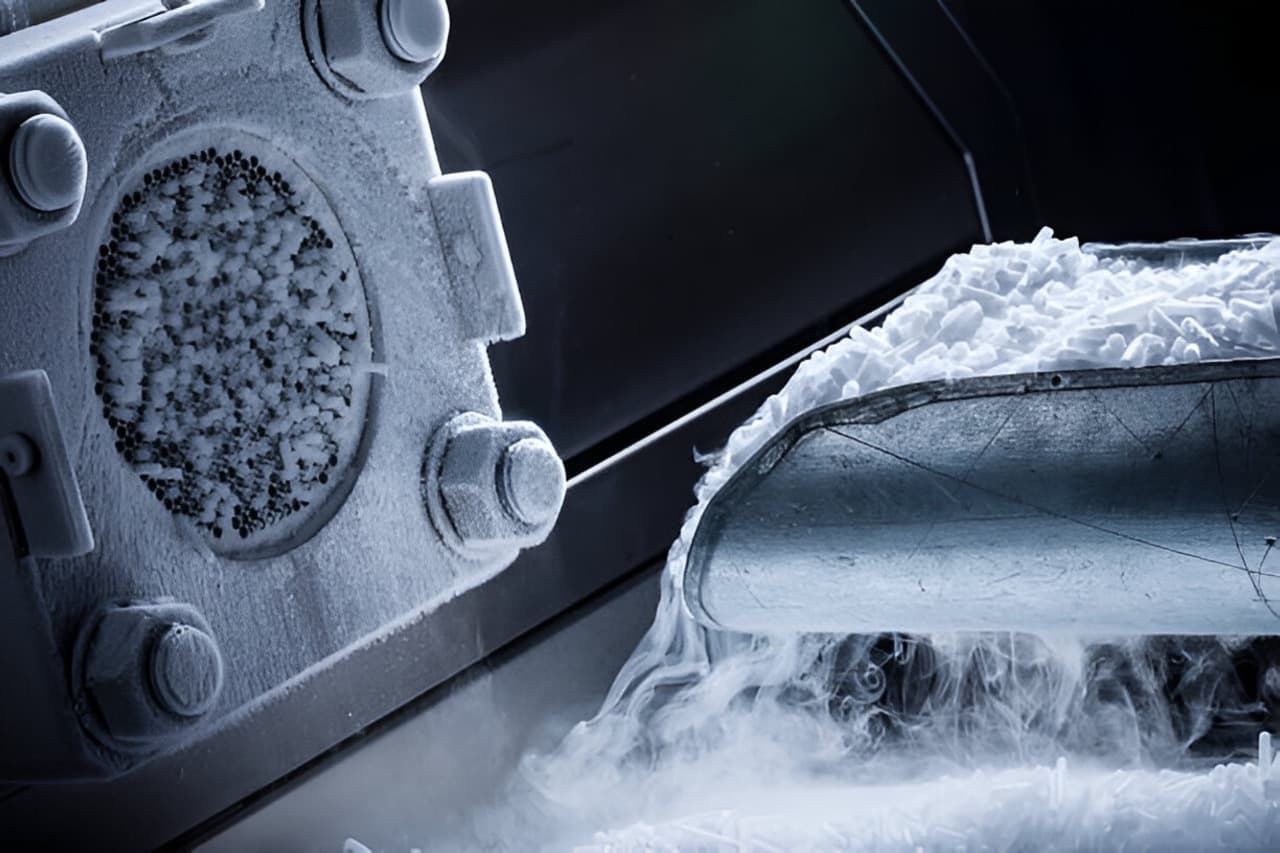
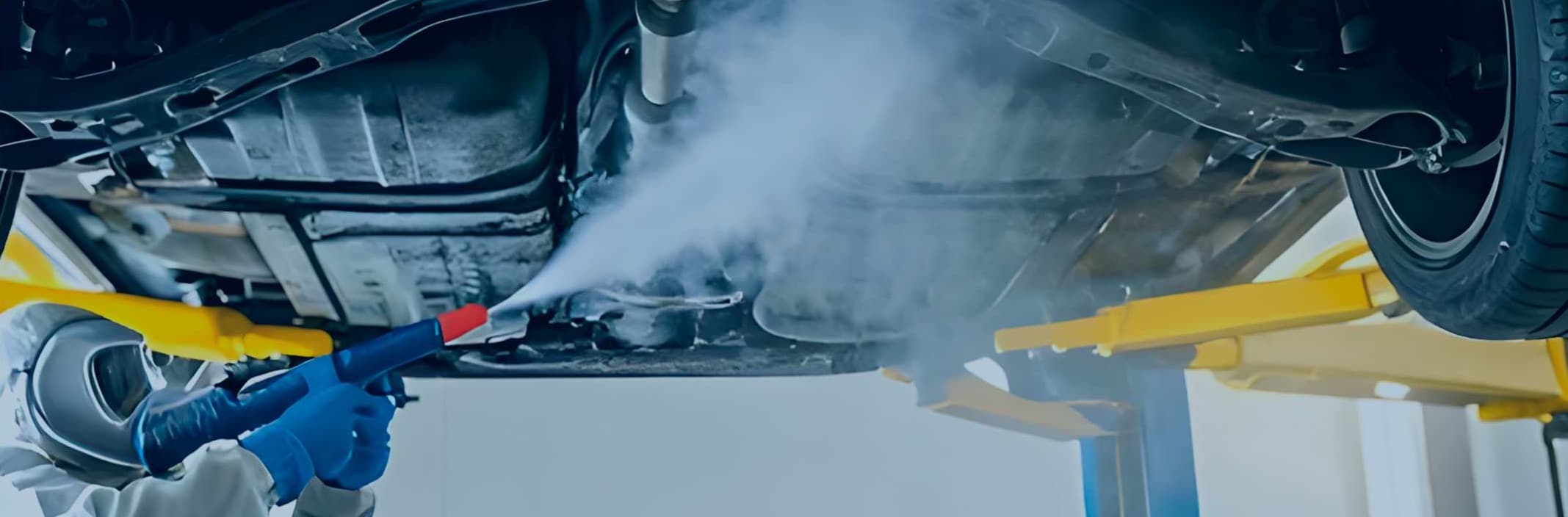
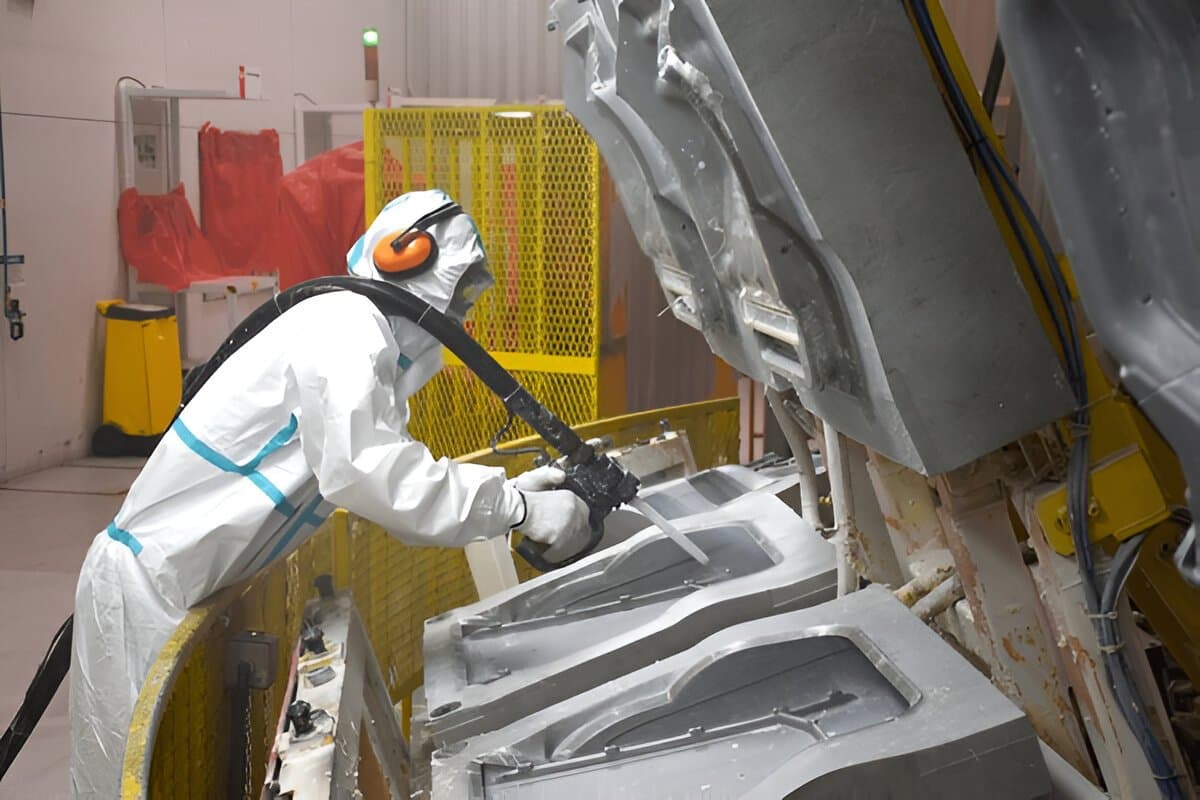
Dry ice blasting is where most of our occupied-building concrete work sits. Solid CO2 pellets hit the surface, the contaminant fractures from thermal shock, and the pellet sublimates. Nothing is left to sweep up except the material that came off the floor.
On concrete that means:
- Oil and grease lifted out of the top layer of pores rather than pushed deeper
- Tire rubber and traffic film off ramps and drive aisles
- Efflorescence and light road-salt staining without adding water
- Biofilm and organic growth in wet plant environments
- Failed coating and adhesive residue in patches, without profiling the whole floor
What it does not do is cut profile. Dry ice will not turn CSP 2 into CSP 5. If the spec calls for aggressive texture, dry ice is a cleaning step ahead of a mechanical step, not a replacement for it.
The other advantage on live sites is that nothing conducts and nothing gets wet. We have cleaned around energised panels and running conveyor lines at food plants on Annacis Island because the process adds no moisture and no chemical residue that would show up on a swab. More on that process is on our dry ice blasting page.
Where laser fits on a concrete job
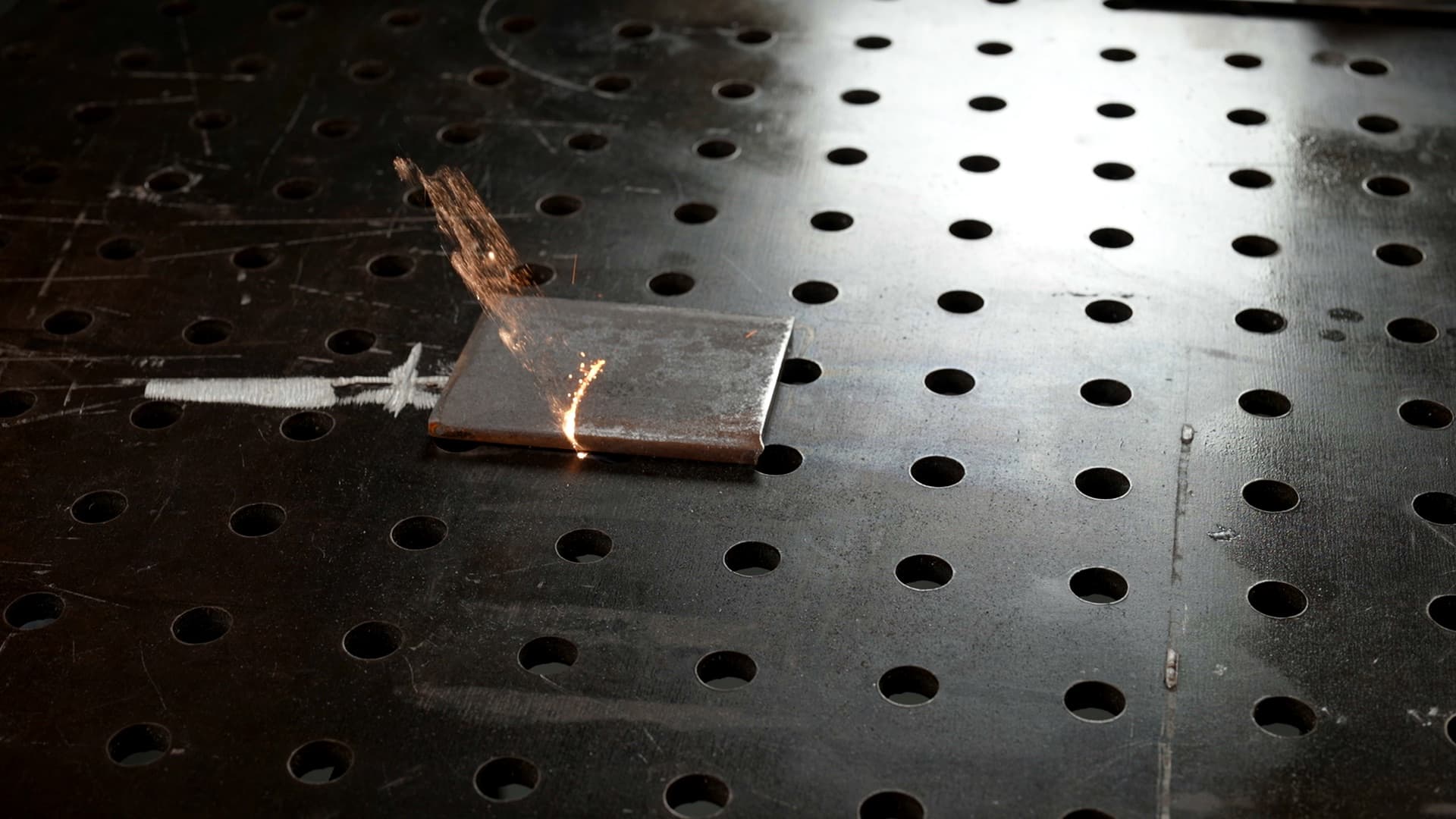
Laser is the precision tool, and on concrete it earns its keep in narrow places rather than across open floors.
Line striping and directional markings in a parkade. Graffiti and paint on structural columns where the surrounding concrete has to stay untouched. Rust bleed from embedded rebar and anchor bolts. Coating removal on a 2 m² patch where masking off the area would cost more than the cleaning.
Rate is the constraint. A handheld unit at $180 to $260 per hour in Greater Vancouver makes sense over a few dozen square metres of intricate work. It does not make sense on a 4,000 square foot loading bay, and any contractor telling you otherwise is selling equipment time. Our laser cleaning page covers substrate limits in more detail.
Also worth knowing: laser is superb at ferrous contamination and thin organic films, and unremarkable at deep oil saturation. Concrete that has been drinking hydraulic fluid for a decade needs a poultice or degreasing step first, whatever tool comes after.
Real BC pricing brackets
These are the ranges we quote in the Lower Mainland in 2026. Treat them as brackets, not a price list, because access and contamination move them more than square footage does.
Dry ice blasting on concrete: $2.50 to $6.00 per square foot for traffic film, oil, and coating residue. Typical jobs land between $1,500 and $8,000. A 200-stall parkade ramp system, done overnight in sections, is usually a three-night $12,000 to $18,000 scope.
Laser cleaning on concrete: $180 to $260 per hour plus $350 to $600 mobilization, which works out to roughly $8 to $20 per square foot on detailed work. Right tool for 50 square metres, wrong tool for 500.
Shot blasting or diamond grinding for profile: $1.75 to $3.50 per square foot on clean, open, unoccupied slab. Add containment at $1,500 to $3,000 per day, dust monitoring at $600 to $1,200 per day where an exposure control plan requires it, and waste disposal at $180 to $320 per tonne.
The combination that usually wins: dry ice first to strip contamination, mechanical second and lighter than planned because the machine is no longer fighting oil. On the parkades we have re-prepped after a coating failure, that sequence has run 15 to 25 percent under a full grind-and-vacuum scope, mostly because the grinding hours drop.
What drives the ±50 percent spread on any of these: how deep the oil went, whether the old coating is single-component or an epoxy that fights back, ceiling height and access for equipment, whether the work is daytime or restricted to a 10 p.m. to 6 a.m. window, and whether adjacent tenants need to keep operating.
The downtime number nobody puts in the quote
Facility managers price cleaning. Finance prices closure.
A 200-stall Richmond parkade at $185 per stall per month generates about $1,200 a day in parking revenue. Close half of it for six days and the disruption costs more than the difference between two prep methods.
A food plant line running at $2,800 an hour of contribution margin loses $22,400 in an eight-hour shift. That is why the food processors we work with in Delta and Port Coquitlam care far more about whether we can work around running equipment than about our per-square-foot rate.
Run the comparison as total hours the space is unavailable, not as dollars per square foot. Dry ice work in an occupied building often costs 30 to 60 percent more per square foot than open-slab shot blasting and still comes out cheaper, because the space keeps earning while we work.
How to write a prep spec that holds up
Four things I look for in a scope before quoting, and their absence tells me the coating failure is already scheduled:
- The coating manufacturer’s required CSP, in writing. Not "prepare to a suitable profile."
- A contamination history for the slab. Age, what was spilled, what coatings went on and when.
- A moisture test result. Calcium chloride or in-situ RH per ASTM F2170, because a clean, well-profiled slab still fails under a coating if the vapour drive is high.
- A named acceptance step before coating goes down, with a test patch on 5 to 10 square metres of the worst area.
The test patch is the cheapest insurance on the job. It costs a couple of hours and it settles arguments about method before there is a floor riding on the answer.
Who is doing the work
Laser Sharks runs laser and dry ice cleaning across Greater Vancouver and the rest of BC, with 20 years of industrial cleaning behind the crew. We work to WorkSafeBC requirements, carry full liability coverage and WCB clearance, and provide the exposure control documentation your safety officer will ask for before we set foot on a slab. We were named CBRB Best Cleaning Services in BC for 2025.
We also say no when a mechanical grind is the correct answer. Selling the wrong method once buys a callback and loses a client.
The recommendation
For occupied buildings, food and pharmaceutical environments, wastewater structures, and any slab where the neighbours cannot be shut down: clean with dry ice first, then apply the lightest mechanical step that meets the coating spec. You will spend less total, close less space, and avoid the silica control apparatus for most of the scope.
For empty, open, new-construction slab with no contamination history: shot blast it. It is faster and cheaper and there is nothing to be clever about.
For striping, patches, rust bleed, and detail work under about 50 square metres: laser, and skip the masking entirely.
If you have a coating going down this fall and you are not sure which category your slab falls into, send photos and the coating data sheet through our quote page or call the shop. A site visit in the Lower Mainland takes about an hour, and the test patch tells us more than any spec ever will.