
On an eight-cavity closure mold running nights in Delta’s Tilbury industrial area, cavity 6 starts showing burn marks at the end of fill. The process tech raises injection pressure, and two hours later cavity 2 is flashing. Both defects come from vents packed with gas residue. In most shops the fix is a teardown: pull the mold, wait for it to cool, strip it on the tool room bench, scrub, reassemble, rehang, reheat and requalify. That costs a shift.
Injection mold cleaning in BC can be done with the mold still hanging in the press. Dry ice blasting cleans cavities, vents and parting lines at operating temperature, and laser cleaning deals with rust and baked-on carbon once a mold is already on the bench. Neither method uses solvent, abrasive media or water, so the only waste is the residue that came off the steel. Below is what each method does, where each one stops, and what the work costs in the Lower Mainland.
What builds up inside a production mold
Every resin leaves something behind. Gases and volatiles from the melt condense on the coolest steel they reach, usually the vent lands, the parting line and the far end of the cavity. What collects depends on the material:
- Acetal (POM) leaves a white, chalky formaldehyde-based deposit that grows fast on long runs.
- PVC gives off hydrogen chloride that attacks mold steel. PVC tools are built in stainless for that reason, and they still pit when residue is left sitting on them.
- Flame-retardant grades of PP, ABS and nylon plate out additives as a hard, glossy film.
- Release sprays, ejector pin grease and slide lubricant creep onto the parting line and bake there.
Vents are where the trouble starts. A vent land is cut 0.01 to 0.05 mm deep, depending on the resin, so a film thinner than a sheet of paper can close it. When air in the cavity can’t escape, it compresses and ignites at the end of fill (molders call it dieseling), and you get burn marks, short shots and gloss differences between cavities. Chasing those defects with more injection pressure or speed pushes melt into the parting line, and flash follows.
Rust is the other build-up, and in the Lower Mainland it shows up in winter. A mold running chilled water at 10 to 15 °C sits below the dew point of a damp shop in Surrey or Port Coquitlam. It sweats every time the press stops, and P20 steel grows a rust bloom within days.
Why a mold teardown costs more than the cleaning
Count the hours behind a pulled mold. On a mid-size tool in a 300-tonne press, the sequence runs roughly like this: an hour or two of cooling before anyone can handle it, an hour to pull it and move it to the tool room, two to four hours of teardown, cleaning and reassembly, then rehanging, reconnecting water and hot runner zones, heating back up and running first articles for QC. Six to eight hours of press time is normal. Large multi-cavity hot runner molds take longer.
At a machine rate of $80 to $150 an hour, six hours is $480 to $900 in press time before you count the toolmaker, the setup tech, purge compound and the scrap from restart. Do that once a month and one mold costs you about 72 press hours a year. In-press dry ice cleaning on the same schedule usually takes 30 to 90 minutes per visit, which hands back more than 50 of those hours per mold.
The cleaning itself wears the tool. Brass brushes and scouring pads round off shut-off edges and parting lines, and a rounded edge flashes whatever the process window says. Glass bead and plastic media change the gloss of etched textures and lodge in ejector pin bores, where they cause galling. On a production injection mold that is often worth six figures, those are expensive habits.
Solvent cleaners bring their own costs. They are flammable near heater bands, need WHMIS handling and ventilation, and leave spent solvent and rags that go out as hazardous waste. They also don’t get into a vent unless someone works at it with a brass shim.
For plants with environmental targets, or with customers who audit them, the waste stream counts too. Dry ice leaves no spent media, no solvent drums and no wash water. The CO2 used to make the pellets is recovered from other industrial processes, and what gets vacuumed up afterwards is the residue that came off the mold.
Dry ice blasting in the press
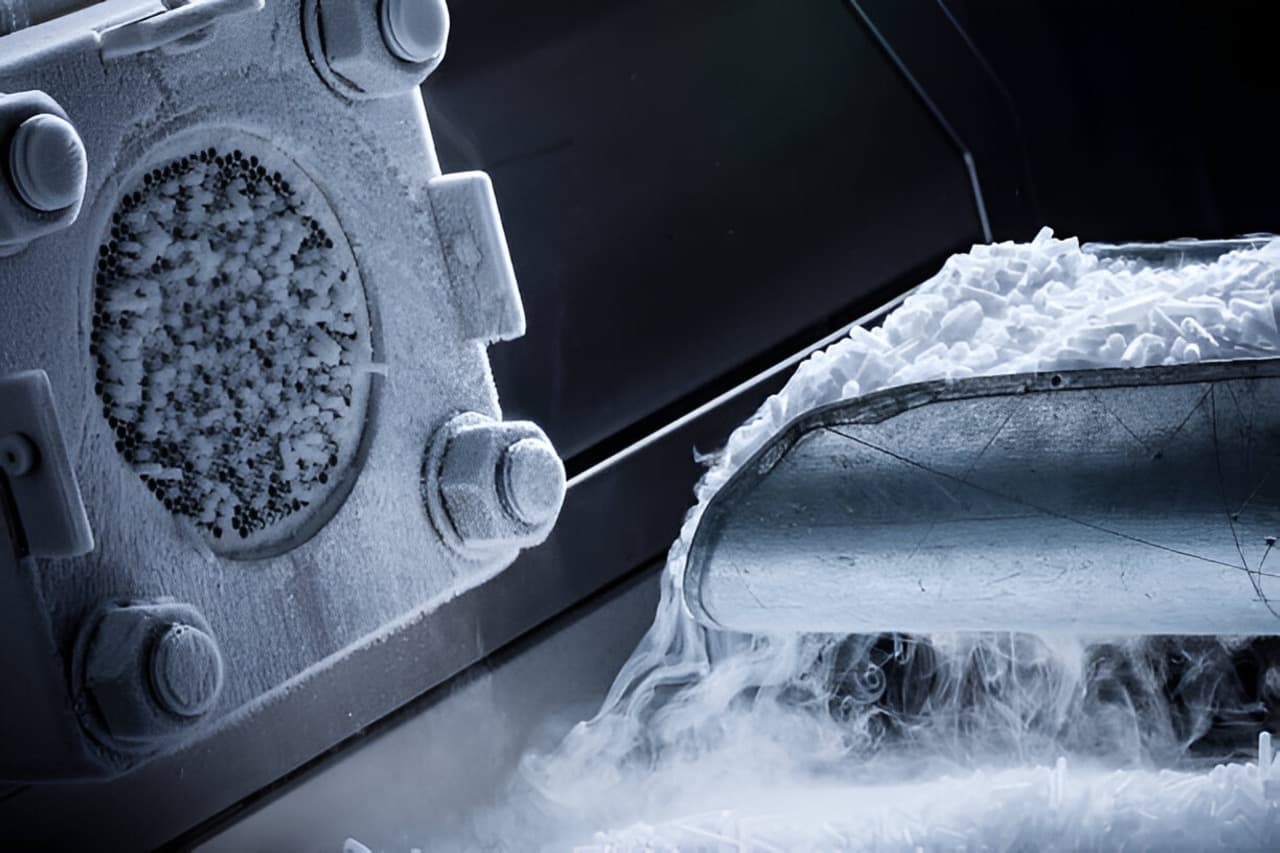
Dry ice blasting is the in-press method. Pellets at -78.5 °C hit the residue, the cold makes it brittle and shrink against the warm steel, the impact cracks it loose, and the pellet turns to gas. No water, media or chemical is left in the cavity or the vents. The mold stays at operating temperature, so there is no cooldown, no reheat and no trip through the dew point.
A typical in-press clean goes like this. Your setup tech opens the mold and locks out the press and robot under your procedure. We cover heater connectors and thermocouple wiring, even though dry ice doesn’t conduct. On polished and textured cavities we run fine particles shaved from block ice at 40 to 80 psi, which removes residue without changing an SPI A-2 polish or the grain of an etched texture. Heavier deposits on parting lines, slides, lifters and vent channels get larger pellets at higher pressure. The residue falls onto the platen and tie bars, and we vacuum it before the mold closes. Most molds take 30 to 90 minutes. Then your tech runs a few shots and QC checks the first parts.
Two cautions. If the mold runs chilled water, we clean it with water flowing at operating temperature or blow it dry with compressed air afterwards, because a cold cavity in a humid building will sweat. And in a cleanroom cell making medical parts, we plan the visit with your QA team, since loose residue has to be contained with sheeting and vacuum.
Dry ice has limits. It won’t remove pitted rust or restore a corroded cavity; that is polishing work for a toolmaker. It doesn’t reach scale inside cooling channels or residue inside hot runner nozzles. Carbon baked for months into a deep vent can take several passes, or the laser.
Laser cleaning for molds on the bench
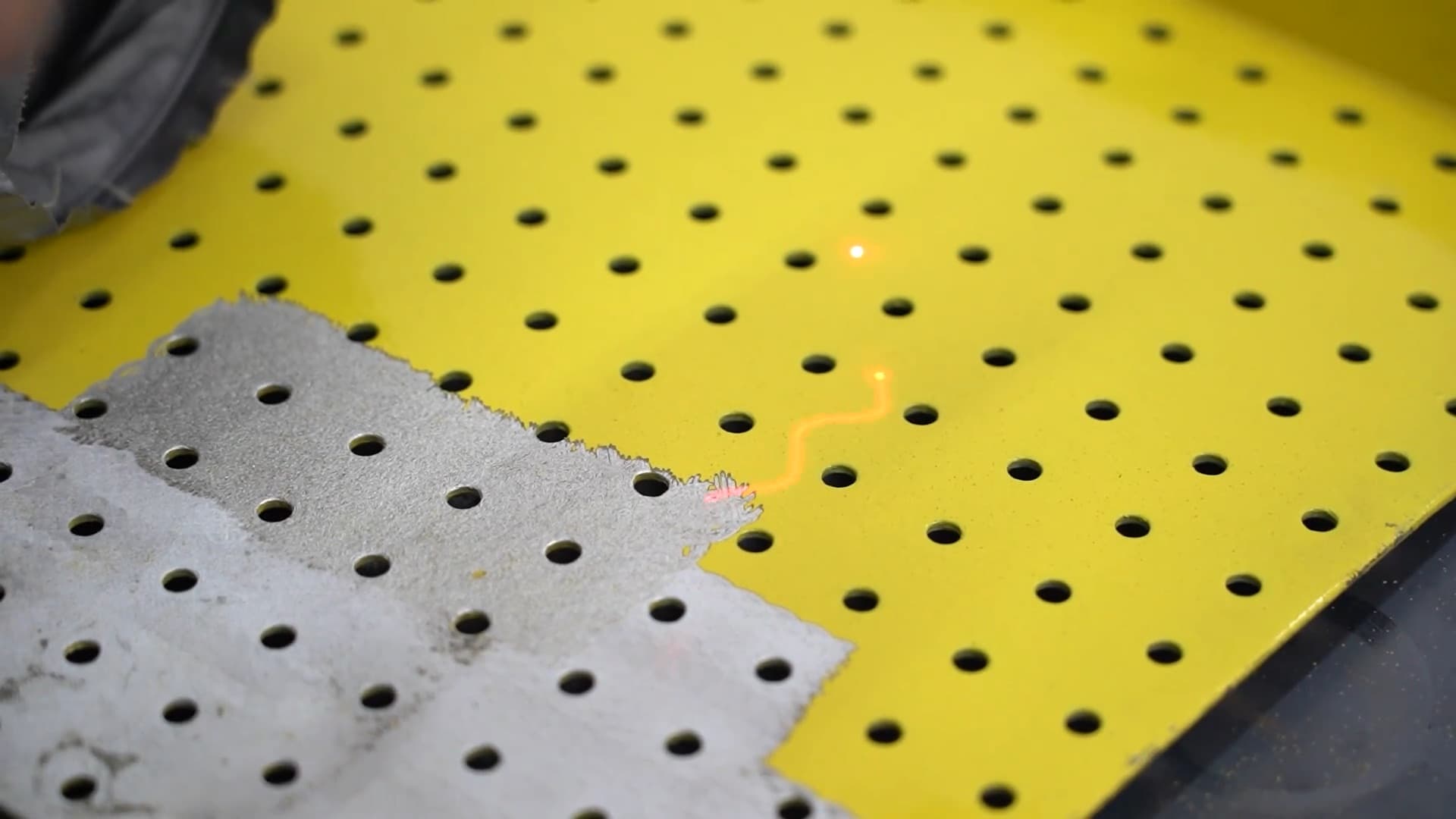
When a mold is out of the press for maintenance, or has been sitting in storage, laser cleaning does the work dry ice can’t. A pulsed fiber laser removes rust, carbon and baked release agent layer by layer and stops at bare steel. There is no media to lodge in pin bores, and with the right settings the hardness of H13 or P20 doesn’t change.
The laser earns its place in three situations. Rust on stored molds is the most common. Tooling for seasonal and low-volume parts often spends months in an unheated warehouse in Langley or a container at the back of the lot, and a wet BC winter leaves orange bloom on every exposed face. Then there is hard carbon on vents, shut-offs and gate areas that dry ice only thins. Rubber and composite tooling is the third: compression molds for seals and gaskets, and fibreglass layup tools for boat parts, collect release agent and cured residue in heavy layers.
It has its own limits. A laser works line-of-sight, so deep ribs, narrow slots and undercuts behind slides are better reached with dry ice. On mirror-finish cavities (SPI A-1) we run a test spot on a non-critical area first, and sometimes the answer is to leave that cavity to dry ice. We would rather tell you that before the job than after it.
Our usual split in an injection molding plant is dry ice for routine cleaning on the press and laser for rust and anything that comes to the bench. Plants that use both tend to save the full teardown for repairs and worn components.
Safety on a molding floor
Molding shops already run lockout on every press, and we work inside that program. Two hazards are specific to our methods.
Dry ice blasting turns into CO2 gas. A molding hall is a large space, but pits, press enclosures and low areas around the platen can hold it. Our crew wears personal CO2 monitors and works to the WorkSafeBC 8-hour exposure limit of 5,000 ppm. The nozzle also runs well over 100 dBA, far above the 85 dBA WorkSafeBC exposure limit, so the cell is marked off and anyone nearby wears hearing protection.
Laser work happens inside a marked zone with barriers, eyewear rated for the laser’s wavelength for everyone inside, and fume extraction at the nozzle. Residue from PVC and flame-retardant resins shouldn’t be breathed, so extraction runs the whole time.
Before the first visit, ask any contractor for proof of liability insurance, WorkSafeBC coverage and a written safe work procedure for the method they use.
What injection mold cleaning costs in BC
Most molding jobs fall inside the $1,500 to $8,000 range we quote for dry ice work across the Lower Mainland. Typical brackets:
- In-press dry ice cleaning of one to three molds in a half-day visit: $1,500 to $2,500.
- A full shift working through six to ten molds during a planned stop: $3,000 to $6,000.
- Large automotive-size or multi-cavity hot runner molds over several shifts, or a full tool library before a shutdown: $6,000 to $10,000 and up.
- A day of laser work in your tool room on rust, vents and stored molds: $1,200 to $2,500.
Several things move a quote by half in either direction. Build-up thickness comes first: a mold cleaned every few weeks takes a fraction of the time of one left for a year. Access is next, because guarding, robots and tie-bar spacing decide how much of the mold a nozzle can reach in the press. Our dry ice machines need 200 to 400 CFM of compressed air at 100 to 120 psi. Molding plants usually have that capacity, and if yours can’t spare it during production we bring a diesel compressor at $400 to $800 a day. Night and weekend work carries a premium, and cleanroom cells add containment time.
Set that against the press math above. Two avoided teardowns on a busy press roughly pay for a half-day visit.
Cleaning by shot count, and the holiday shutdown
Shops that clean on a schedule spend less per visit than shops that wait for scrap to climb. Shot count, logged by the press, is a better trigger than the calendar. A mold running acetal or a flame-retardant grade may need its vents cleaned every few days of production, while a clean polypropylene job can go months. After the first full clean we can tell you where your molds sit, based on how much came off and where it was.
The Christmas shutdown is the obvious window for a full pass across the press floor, and it matters for storage as well. Two weeks cold in a damp Richmond or Burnaby building is enough to rust a cavity. Cleaning them before the break and putting your rust preventive on dry steel saves a January teardown to polish it off. Shutdown dates across Delta, Surrey, Langley and Abbotsford overlap, so those weeks book up early.
To quote, we need the resins you run, the number and rough size of the molds, press tonnage, the cavity finish (polish grade or texture), photos of the worst build-up, your compressed air capacity and the window you have in mind. For a full press floor we visit first, and we can clean one mold in the press as a test so your setup tech and QC see the parts before you commit the downtime.
Laser Sharks crews are WorkSafeBC compliant and fully insured, and they work under your lockout and site safety program. The company was named CBRB Best Cleaning Services in BC for 2025. We clean molds, presses and tooling for plastics, rubber and composite manufacturers from Richmond and Annacis Island out to the Fraser Valley.
Send the details through our quote form or call 236-660-4248. We will tell you which of your molds can be cleaned in the press, which belong on the bench, and which need a toolmaker instead.