Ask the line lead at a powder coating shop in Surrey’s Campbell Heights what changed over the year and you will hear a familiar list. Parts on the back rack come out thin in the corners. Powder use is up even though the order book is flat. Flakes of something brown keep landing on white parts, and the insurer’s risk engineer wrote "overspray accumulation" in the last report. All of that points to the same job. Paint booth cleaning in BC tends to get pushed back until a slow week that never arrives, and then a crew of shop staff spends five days on ladders with scrapers and a drum of thinner.
There is a faster way to do most of it, and a few parts of the job where the old way is still the right call. This guide covers both, for liquid spray booths and for powder coating lines: the booth itself, the hooks and racks, the conveyor and the cure oven.
What builds up on a paint booth and powder coating line
A liquid spray booth collects overspray on everything the air passes. Walls and doors carry a crust that gets thicker near the spray position. Light panel glass dims. Floor grates in a downdraft booth fill until the airflow pattern changes, and the exhaust plenum and fan blades pick up a layer that throws the fan out of balance. When that layer dries and cracks, flakes fall back into the booth and onto wet parts.
A powder line builds up differently. Powder that misses the part settles on booth walls and ceilings, and some of it impact-fuses into a hard skin on surfaces the air hits at speed. Every hook and rack goes through the cure oven with the part, so each pass bakes on another thin layer. The overhead conveyor chain and trolleys collect powder, grease and baked residue. Inside the oven, resins that outgas during cure condense on the cooler ceiling and duct openings, then drip or flake onto parts as small dark specks.
Shops notice the symptoms long before anyone names the cause: dirt in the finish, uneven film build, more rework, and booth airflow that no filter change seems to fix.
Hooks and racks: where powder coating quality is lost
Electrostatic powder coating depends on the part being grounded through the hook. Most powder equipment makers want 1 megohm or less between the part and ground. Cured powder is an insulator, so every layer on the contact point of a hook pushes that number up. Once enough coats have built up, the charged powder has nowhere to go. Operators see poor wrap around edges, thin film inside corners and recesses, and a rougher finish on the parts at the end of a rack. The usual reaction is to turn up the gun output, which burns more powder and makes the thin-corner problem worse.
A simple example shows the cost. A fabricator spending $6,000 a month on powder who loses 10 percent of transfer efficiency to poorly grounded hooks is paying around $600 a month for powder that ends up in the reclaim or the filters. Rejects and recoats come on top of that.
Shops strip hooks and racks four ways. Burn-off ovens and sand-bath pyrolysis turn the coating to ash at high temperature. Chemical strip tanks dissolve it. Abrasive blasting knocks it off. Laser stripping vaporizes it.
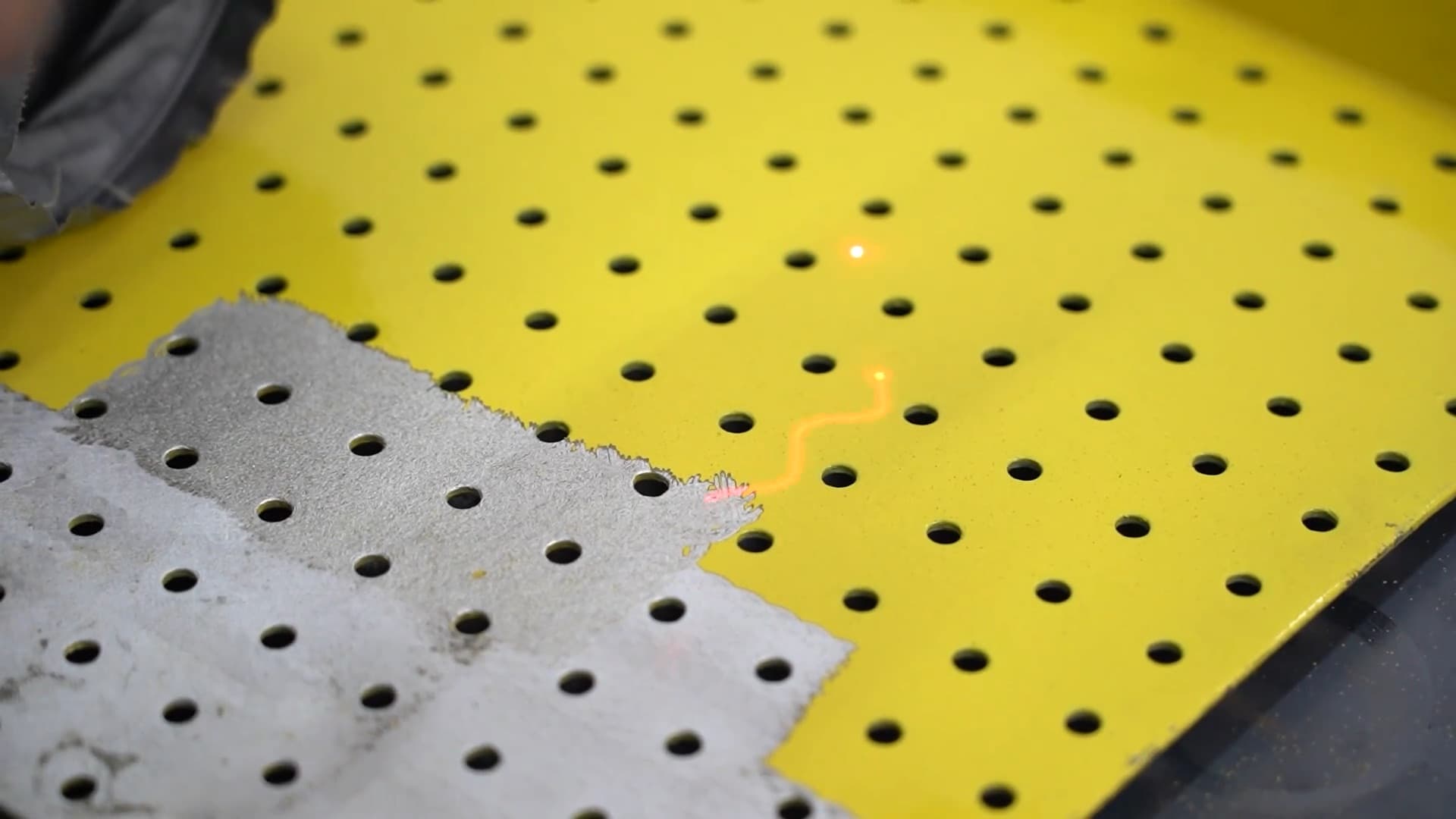
Laser cleaning suits the contact points: hook tips, saddles, rack prongs and the touch points where the part hangs. The laser takes the coating down to bare metal, leaves the hook’s shape and thickness alone, and embeds no media in the steel. There is no tank to maintain and no spent stripper to haul away. On light build, several hundred hook tips can be stripped in a day on your shop floor, and they go straight back on the line.
We will also tell you where laser loses. A rack carrying five millimetres of powder over its whole length is a slow laser job, and a burn-off service will do it for less per kilo. The setup most shops end up with is burn-off for the full rack strip a few times a year, plus laser on the contact points between those runs so grounding never drifts far. If the racks can’t go in an oven, or the shop doesn’t want a strip tank on site, laser takes the whole job.
Dry ice cleaning inside the booth, conveyor and oven
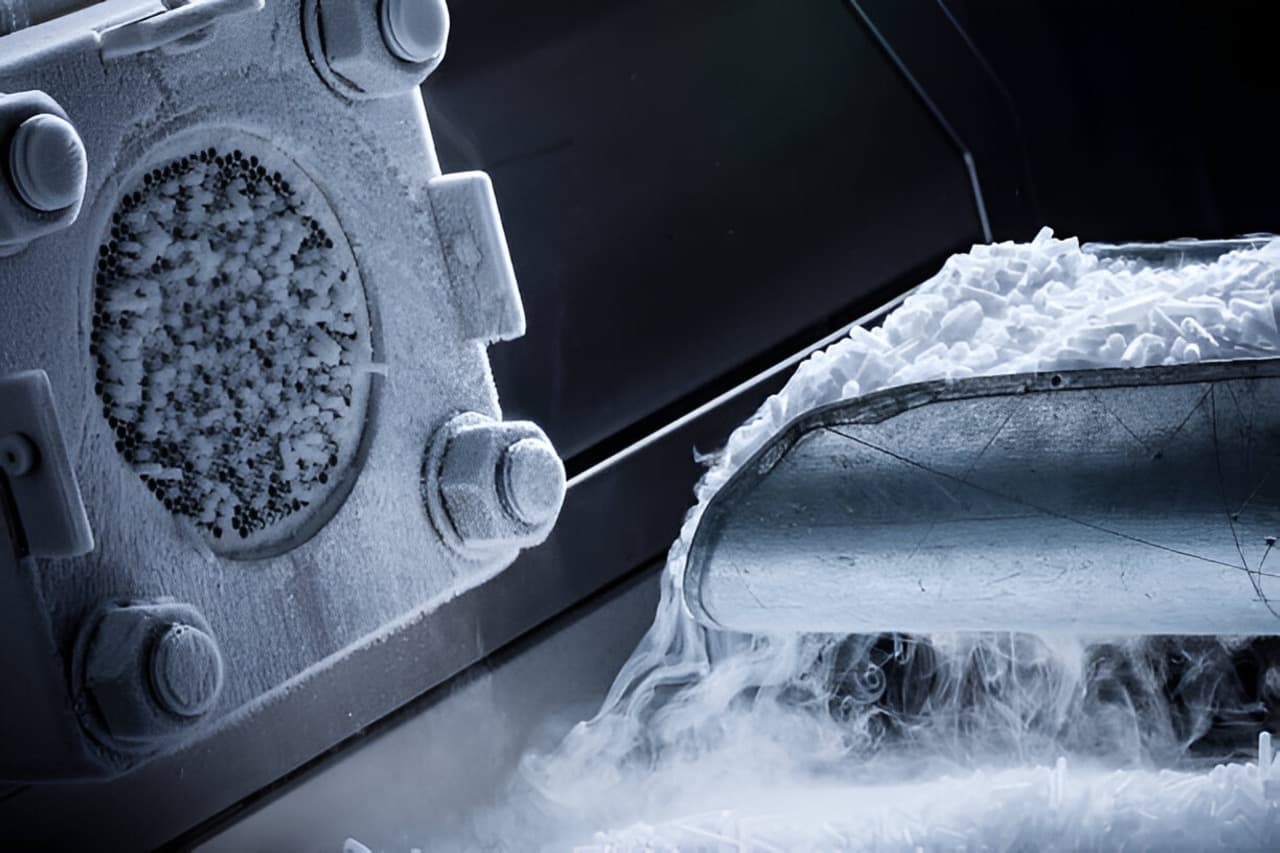
The booth shell, the conveyor and the cure oven are dry ice blasting work. Dry ice pellets hit the surface at -78.5 °C. The cold makes the overspray brittle and shrink against the metal under it, the impact cracks it, and the pellet turns to gas and lifts the pieces off. Nothing is left behind except the paint or powder that came off, which we sweep and bag.
That last part matters more in a coating shop than almost anywhere else. Scraping and wiping with lacquer thinner leaves a solvent film and sometimes silicone from the rags or the cleaner, and either one can cause craters and fisheyes in the next coat. Dry ice leaves no film. It also leaves no water, so the conveyor chain doesn’t rust, the oven panels don’t need drying, and the line can restart as soon as the filters are changed.
Most of a booth cleans well this way: walls, ceilings, doors, the frames and glass of light panels at reduced pressure, the exhaust plenum, fan blades and the gun movers. Conveyor chain and trolleys are often cleaned while the conveyor indexes slowly past the blaster, which saves crawling along the rail with a scraper. The cure oven gets cleaned once it has cooled, with the burner locked out.
Dry ice has limits here too. Thick, fully cured two-part overspray on floor grates comes off slowly, and the cheaper answer is usually a spare set of grates and a burn-off service. Ductwork past arm’s reach of the plenum belongs to a duct cleaning contractor. We list both at the site visit so the quote covers only what dry ice does well.
Why solvent cleaning costs more than the thinner
The in-house method looks cheap because the crew is already on payroll. A typical in-house clean keeps shop staff on ladders with scrapers for four to six days. The thinner puts solvent vapour into an enclosed room, so the crew needs respirators, ventilation and an exposure plan under WorkSafeBC rules. At the end there is a drum or two of spent thinner mixed with paint, which counts as hazardous waste under BC’s Hazardous Waste Regulation and has to go out with a licensed carrier. And the line sits idle the whole time.
Picture a fabricator in Langley running one shift on a powder line that coats about $20,000 of parts a day. A week of in-house cleaning means five days of delayed shipments and a stack of overtime to catch up afterwards. A dry ice crew can clean the booth, the conveyor run and the oven over a Saturday and Sunday, so the line comes back on Monday morning. On most lines that weekend job costs less than one lost production day.
Abrasive blasting the booth is not a real option. Grit gets into the conveyor, the reclaim system, the oven and every gap in the booth panels, and the line will chase contamination for weeks. Blasting hooks in-house with sand brings the silica dust rules WorkSafeBC enforces into a shop that may not have an exposure control plan for them.
Safety and fire rules in a coating shop
Fire inspectors and insurers treat overspray as fuel. The BC Fire Code covers spray coating operations, and NFPA 33 is the standard most insurance risk engineers refer to when they flag residue on booth walls, plenums and ducts. A cleaning record with dated before and after photos is often what closes that item on the next survey report, so we provide one.
Both of our methods bring their own hazards, and we plan for them with your maintenance lead:
- A laser is an ignition source. Hook and rack stripping happens outside the booth, away from loose powder and solvent, with the spray area shut down. The laser zone is barriered, everyone inside wears eyewear rated for the wavelength, and fume extraction runs at the nozzle because the coating leaves as fume.
- Powder dust is combustible. The dry ice machine and hose are grounded, and the booth is vacuumed of loose powder before blasting starts.
- A booth is an enclosed room, and CO2 from the pellets collects low. The booth exhaust runs during blasting, our crew wears personal CO2 monitors, and we work to the WorkSafeBC exposure limit for carbon dioxide of 5,000 ppm over an eight-hour shift.
- Dry ice blasting runs well over 100 dBA at the nozzle, so anyone nearby wears hearing protection.
The booth’s electrical gear, sensors and gun controls are locked out under your procedure. Dry ice doesn’t conduct electricity and won’t soak anything, but lockout is still the rule.
What paint booth and powder line cleaning costs in BC
Most coating shop jobs fall inside the $1,500 to $8,000 range we quote for dry ice work across the Lower Mainland. Typical brackets:
- One liquid spray booth with walls, doors, light panels, plenum and exhaust fan, cleaned in one shift: $1,800 to $4,000.
- A powder booth with its conveyor run and the cure oven interior: $4,000 to $9,000, depending on conveyor length and oven size. Lines that need two shifts sit at the top of that range.
- A day of laser stripping on hooks and rack contact points in your shop: $1,200 to $2,500. Racks with heavy full-length build are quoted by the batch after a test.
Several things move a quote by half in either direction. Thickness of the build-up is the first: a booth cleaned every quarter takes a fraction of the time of one left for three years. Access is next, since booth ceilings and oven roofs may need a scissor lift. Our dry ice machines need 200 to 400 CFM of compressed air at 100 to 120 psi, and if your shop system can’t spare it, we bring a diesel compressor at $400 to $800 a day. Weekend and night work carries a premium, and most coating shops want exactly those hours.
Planning the next cleaning
The cheapest paint booth cleaning is the one done before the crust gets thick. Shops that clean booth walls and hook contact points on a fixed schedule spend less per visit and see fewer rejects between visits. The interval depends on volume and coating type, and after one full clean we can tell you where yours should sit. The Christmas shutdown is the obvious window for a full line clean this year, and it fills early across Surrey, Langley, Delta, Port Coquitlam and Abbotsford.
To quote, we need the booth type and size, liquid or powder, conveyor length, oven size, rough hook and rack counts, photos of the worst build-up, your compressed air capacity and the window you have in mind. For full lines we do a site visit first. We can strip a few hooks and blast a test section of booth wall so you see the result on your own equipment before you book the downtime.
Laser Sharks crews are WorkSafeBC compliant and fully insured, and they work under your site’s safety program. The company was named CBRB Best Cleaning Services in BC for 2025. We clean booths, conveyors, ovens, hooks and racks for fabricators and finishing shops from Richmond and Burnaby out to the Fraser Valley.
Send the details through our quote form or call 236-660-4248. We will tell you which parts of your line dry ice and laser can clean on site, and which parts are better sent to a burn-off oven.