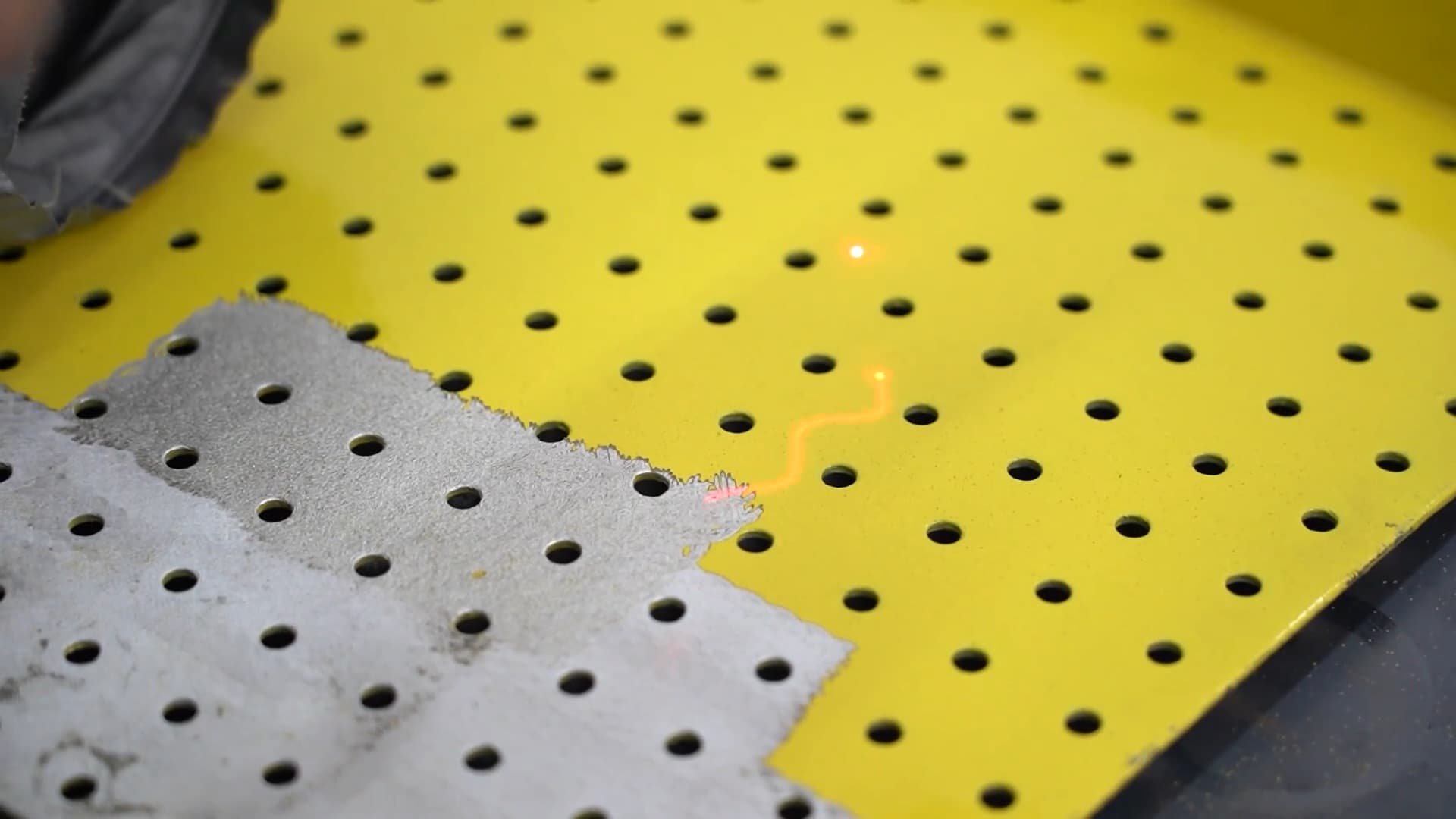
The label on most paint strippers says to let it dwell for 15 to 30 minutes. On four coats of 1970s enamel over a steel door frame, that turns into three applications, two days, a putty knife, and a pail of sludge nobody wants to sign for. We hear some version of that story every few weeks, usually from a maintenance lead who started the job with a can of stripper and called us partway through.
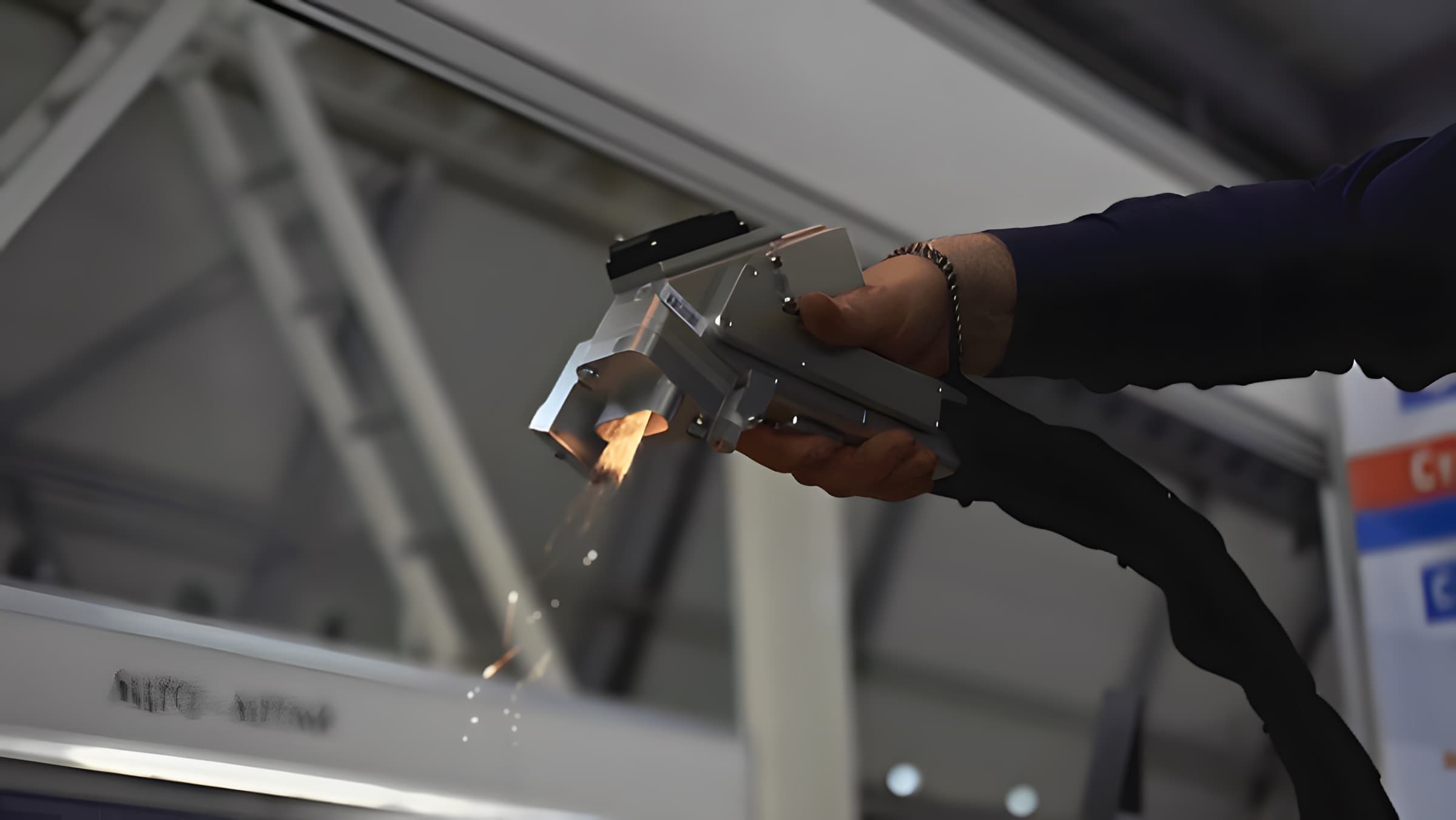
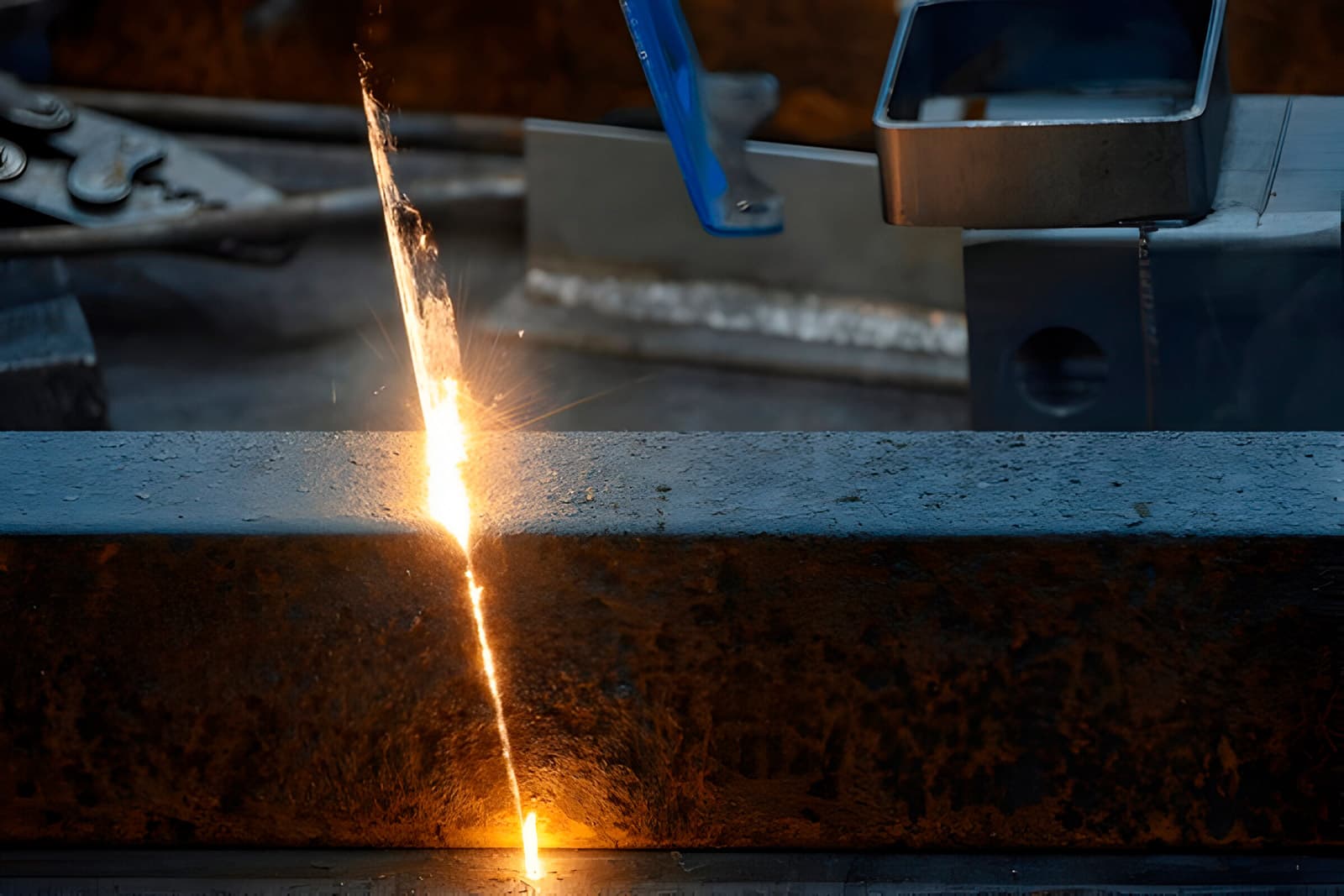
Laser paint stripping skips most of that. No dwell time, no solvent, no rinse water, nothing to scrape. The beam lifts the coating where it lands and the extractor at the nozzle pulls the fume away. You can usually prime the same day.
It isn’t the answer to every painted surface, and wood is a different conversation from steel. Below is how laser paint stripping works, what speeds to expect, how metal and wood each react, where it beats a can of chemical stripper, and the jobs where we’d still tell you to buy one. For the wider service, see our laser cleaning page.
How laser paint stripping works
A paint film and the metal under it react to laser light very differently. Paint is mostly organic binder and pigment. It absorbs the beam, heats within nanoseconds, and breaks apart into vapour and fine particles. Bare steel or aluminum reflects most of that same energy back.
That gap is what makes the process controllable. Every material has an ablation threshold, the energy density at which it starts coming apart. Paint’s threshold sits well below the metal’s. We set the laser between the two, so the beam strips coating until it reaches clean metal and then mostly stops doing anything. On steel, a correctly tuned pass leaves the substrate intact, with no grit pressed into it and no chemical film left on it.
Two kinds of units do this work. Pulsed lasers fire short, high-peak bursts and put very little heat into the part. They’re our default for thin metal, wood, heritage pieces and anything with tolerances. Continuous-wave lasers deliver steady power, strip thick coatings faster, and heat the part more, which suits heavy steel and nothing delicate.
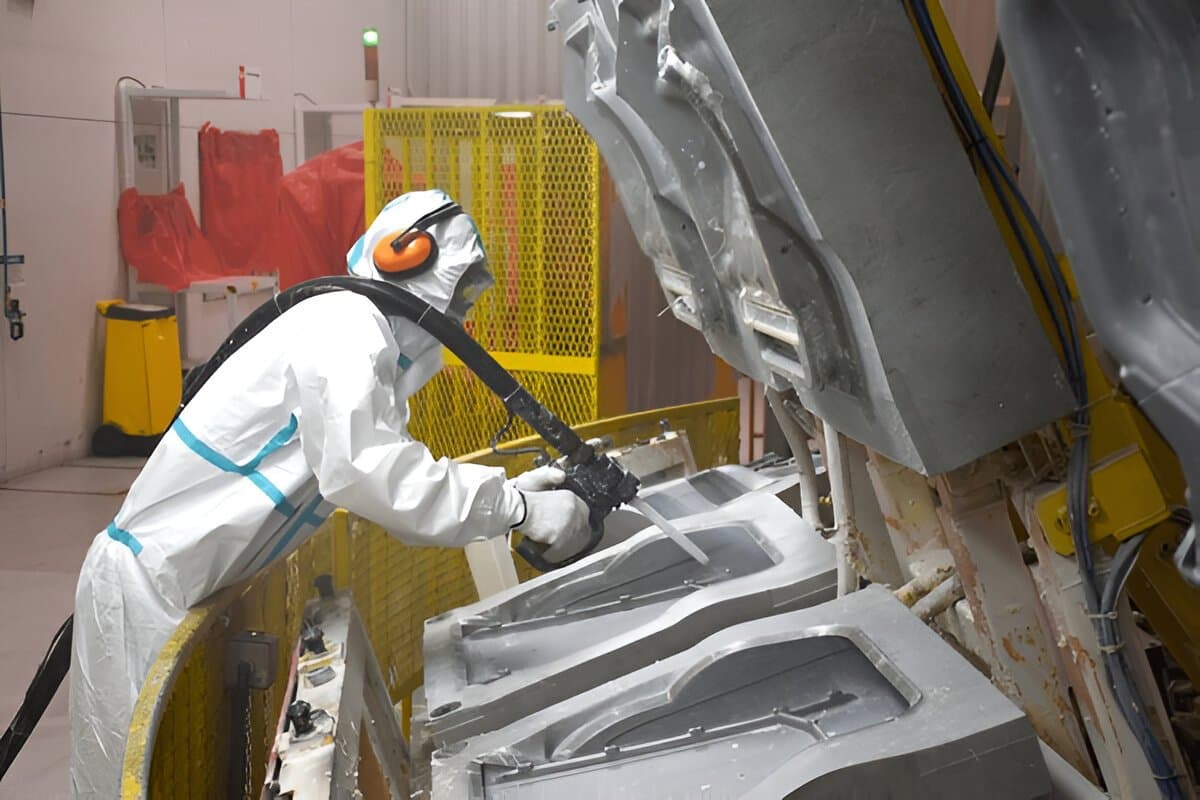
The removed paint doesn’t vanish. It becomes fume and fine dust, and our extraction unit captures it at the head through HEPA and carbon filtration. That’s the honest version of "no waste": the coating still has to go somewhere, but it ends up in a filter cartridge instead of a drum of sludge.
How fast it goes
Speed depends on how much coating is there and what it’s made of. These are production rates we see with a handheld unit on flat, accessible steel:
- One or two thin coats of enamel or primer: 4 to 8 square metres an hour
- Three or more coats of industrial enamel or alkyd: 1 to 2 square metres an hour
- Powder coat: roughly 1 to 2 square metres an hour, depending on film build
- High-build epoxy, coal tar and similar heavy systems: under 1 square metre an hour, sometimes well under
Edges, bolt heads, perforated sheet and inside corners slow things down, because the operator has to angle the beam into every one.
A chemical stripper is often faster to apply, and that’s where most comparisons stop. They shouldn’t. Solvent strippers based on benzyl alcohol need 30 minutes to a few hours to soften one or two coats. Caustic poultices for thick, layered paint sit under plastic overnight, sometimes for a day or more. Then someone scrapes, reapplies on the layers that didn’t let go, scrapes again, washes the surface down and waits for it to dry. With a laser, the area behind the operator is finished.
Done means done.
Most laser paint stripping jobs we quote in Greater Vancouver fall between $1,200 and $6,000, on hourly rates of $180 to $260 that include the operator, the unit and the extraction. A half-day minimum applies, because mobilizing and setting up the safety zone cost the same for two hours of work as for eight.
Metal and wood behave differently
Steel and cast iron
This is where laser stripping works best. Steel and cast iron have high ablation thresholds and tolerate the heat of a pass without complaint. Machine bases, structural members, handrail, tooling, gates, perforated guards: all routine. The photo at the top of this page shows a perforated steel panel losing its yellow coating in a single pass, holes included. A chemical stripper on the same panel would pack sludge into every hole.
Aluminum and galvanized steel
Both are workable, and both need care. Thin aluminum warps if too much heat goes in, so we use pulsed units, keep passes light, and accept slower progress. Galvanized steel is trickier, because the zinc layer is soft and thin, under a tenth of a millimetre on most hot-dip work. Run the settings too hot and the zinc comes off with the paint. We test on a corner first and dial the energy down until the topcoat goes and the zinc stays.
Caustic strippers are worse here. Sodium hydroxide attacks both aluminum and zinc, so on those metals a caustic product can damage the part you’re trying to save.
Wood
People ask us about laser wood stripping more than almost anything else, and it deserves a straight answer: it works, it’s slower, and it needs an operator who has done it before.
Wood absorbs laser light the way paint does. The contrast between coating and substrate that makes steel easy is much smaller on wood, so the margin for error shrinks. Too much energy and the surface scorches. On softwoods like the old-growth Douglas fir in heritage houses around Mount Pleasant, Strathcona and Queens Park in New Westminster, the soft earlywood bands erode faster than the hard latewood, and an aggressive setting leaves a ridged, washboard texture. Light-coloured woods can also darken slightly.
So on wood we use low-power pulsed units, many light passes, and a test patch the client signs off before we go further. Done that way, laser stripping lifts paint off doors, window sashes, mouldings and timber without the gouges a scraper or heat gun leaves, and without soaking the wood.
Soaking matters. Caustic strippers, the usual choice for thick old paint on wood, raise the grain, have to be neutralized afterwards, and turn tannin-rich species like oak noticeably darker. The wood then needs days to dry before it takes a finish. A laser leaves it dry.
Where laser beats chemical strippers
Some jobs we’d do with a laser almost every time.
Occupied buildings. Solvent strippers fill a room with vapour that drifts into offices, kitchens and HVAC returns. A laser in a controlled zone with extraction at the nozzle lets the rest of the building keep working. For a food plant in Richmond or a clinic in Burnaby, that’s often the deciding factor.
Vertical and overhead surfaces. Stripper sags off walls and drips off ceilings. The laser doesn’t care which way the surface faces.
Parts that can’t get wet. Electrical enclosures, machine frames with bearings and seals, anything near a motor. Stripping in place with a laser means nothing gets rinsed and nothing has to come apart.
Detail and tight tolerances. Cast lettering, knurled grips, threaded holes, nameplates and serial plates. The beam goes where the operator puts it, so we can strip around a gasket or a data plate without masking it.
Jobs that need primer the same day. This one gets underrated. Many solvent strippers contain wax to slow evaporation, and that film has to be washed off before new paint will bond. Caustic products need neutralizing. Both usually end in a water rinse, and bare steel that gets wet in a Vancouver November will flash rust before it’s dry. Laser-stripped steel is dry and clean, and in our climate it should be primed within a few hours anyway. Our guide to laser surface treatment before coating covers cleanliness and profile in more detail.
Then there’s the waste. A chemical job leaves softened paint, spent stripper, rags, plastic sheeting and rinse water, all of it contaminated. In Metro Vancouver, the sewer use bylaw limits what can go down a floor drain, and near the Fraser River or Burrard Inlet, stripper runoff into a storm drain becomes a federal Fisheries Act problem. A laser job leaves a filter cartridge and a small bag of collected dust. No chemicals bought, none disposed of. For clients with environmental targets that’s usually the reason they call, and it’s the reason we built the company around chemical-free methods.
When we’d tell you to buy a can of stripper
We’d rather lose a small job than sell the wrong method.
If you’re stripping one chair, a single door or a few small parts, a $40 can of stripper and a free afternoon beats a half-day minimum. Simple math.
Small parts in volume often go cheapest through a shop with a dip tank or a burn-off oven, as long as the parts can travel and nobody minds the turnaround.
The inside of pipes, hollow sections and blind cavities needs line of sight that a laser can’t get. A liquid flows in. The beam doesn’t.
Very thick, soft coatings are a weak spot too. Rubber linings, bitumen and some multi-millimetre elastomeric membranes melt and smear under the beam instead of breaking apart. Depending on the coating, scraping or a solvent may do better. On failing, flaking paint, dry ice often beats a laser for speed. We run both methods from the same crew, so we pick on site rather than by whatever machine is on the truck.
And if your coating spec calls for an angular anchor profile from grit blasting, a laser strips the paint but won’t cut that profile. Abrasive blasting is still the tool for that, and we’ll say so at the quote stage.
Lead paint and WorkSafeBC
Paint on BC buildings and equipment from before the 1990s can contain lead, and some old industrial primers carry chromates as well. No stripping method makes that paint safe. What changes is where the hazard ends up.
A laser turns lead paint into fume and fine dust. That’s exactly why extraction at the head is not optional on our jobs, along with respirators for the operator and a controlled zone around the work. Chemical stripping of the same paint creates lead-laden sludge and rinse water. Sandblasting adds respirable crystalline silica from the media on top of the lead dust, which brings its own set of WorkSafeBC exposure controls.
We test before we start. A paint chip analysis in the Lower Mainland costs about $50 to $150 per sample and takes a few days. If lead comes back positive, the job runs under an exposure control plan, and the collected dust leaves the site as hazardous waste.
Planning a laser paint stripping job
A few details let us give you a firm number instead of a range:
- Photos and measurements of the painted surface, with something in frame for scale
- What the coating is, if you know: enamel, powder coat, epoxy, how many coats, roughly when it went on
- The substrate. Steel, cast iron, aluminum, galvanized and wood each change our settings and our speed.
- Access and power. Height, clearance, and whether there’s a 240-volt circuit within reach.
- What happens next. If a coatings crew follows us, we’ll sequence the stripping so they can prime behind us.
On anything bigger than a few hours, we run a test patch on your actual coating first. Ten minutes on the real surface turns an estimate into a measured production rate, and that’s what lets us quote a fixed price.
Here’s a job profile we see often. A fabricator in Port Coquitlam has a batch of powder-coated steel racks rejected for an adhesion defect, about 18 square metres of coating in total. The threaded mounting holes have to stay clean, which rules out blasting, and the shop has no room for a chemical tank. That’s roughly a day and a half on site, which lands between $3,000 and $4,500 with mobilization, and the racks can go back to the powder line the next morning.
Our crews are fully insured, work under WorkSafeBC requirements on every site, and Laser Sharks was named Best Cleaning Services in BC 2025 by the CBRB. If you have painted steel, aluminum or wood that needs to come back to bare, send us a few photos and we’ll tell you plainly whether a laser is the right tool. You can request a free quote or call 236-660-4248.