The worst swab result I have seen in a BC food plant did not come from dirt. It came from the cleaner. A Richmond ready-to-eat processor had foamed a conveyor frame with chlorinated alkaline, rinsed it once, and moved on. The QA tech’s pH strip on the hollow rail came back at 11 the next morning. That is a chemical hazard, logged in their own preventive control plan, created by the cleaning step itself.
That is the frame I want you to hold when you weigh dry ice blasting vs chemical cleaning for food-grade equipment. Not which method is greener. Not which one the sales rep likes. Which one leaves your audit file cleaner at the end of the shift. QA managers and plant sanitation leads are the people who live with the answer, so this piece is written for them, with BC numbers.
What the auditor writes down
A CFIA inspector at a federally licensed plant, or a Fraser Health or Vancouver Coastal Health officer at a provincially permitted one, is not grading your effort. They are checking that the hazard you identified was controlled and that you can prove it.
For cleaning, that turns into four questions. Was the soil removed? Was anything left behind that should not be there? Did the process introduce a new hazard, usually moisture or chemical residue? And is there a record that a competent person verified all of the above?
Chemical cleaning answers the first question well and struggles with the second and third. Dry ice blasting answers the first three cleanly and needs help with the fourth, because most plants have never written a procedure for it. We will get to the paperwork.
Residue is a hazard in your own plan
Every caustic, chlorinated alkaline, acid descaler and quat sanitizer in your chemical room has an SDS, a dilution ratio, a contact time, and a rinse requirement. Miss the rinse and the residue sits in the seam of a conveyor return, the underside of a slicer guard, the thread of a hopper bolt. Under the Safe Food for Canadians Regulations that residue is a chemical hazard your preventive control plan is supposed to control. Your verification step, the pH strip or the conductivity check, exists because the industry knows rinsing fails.
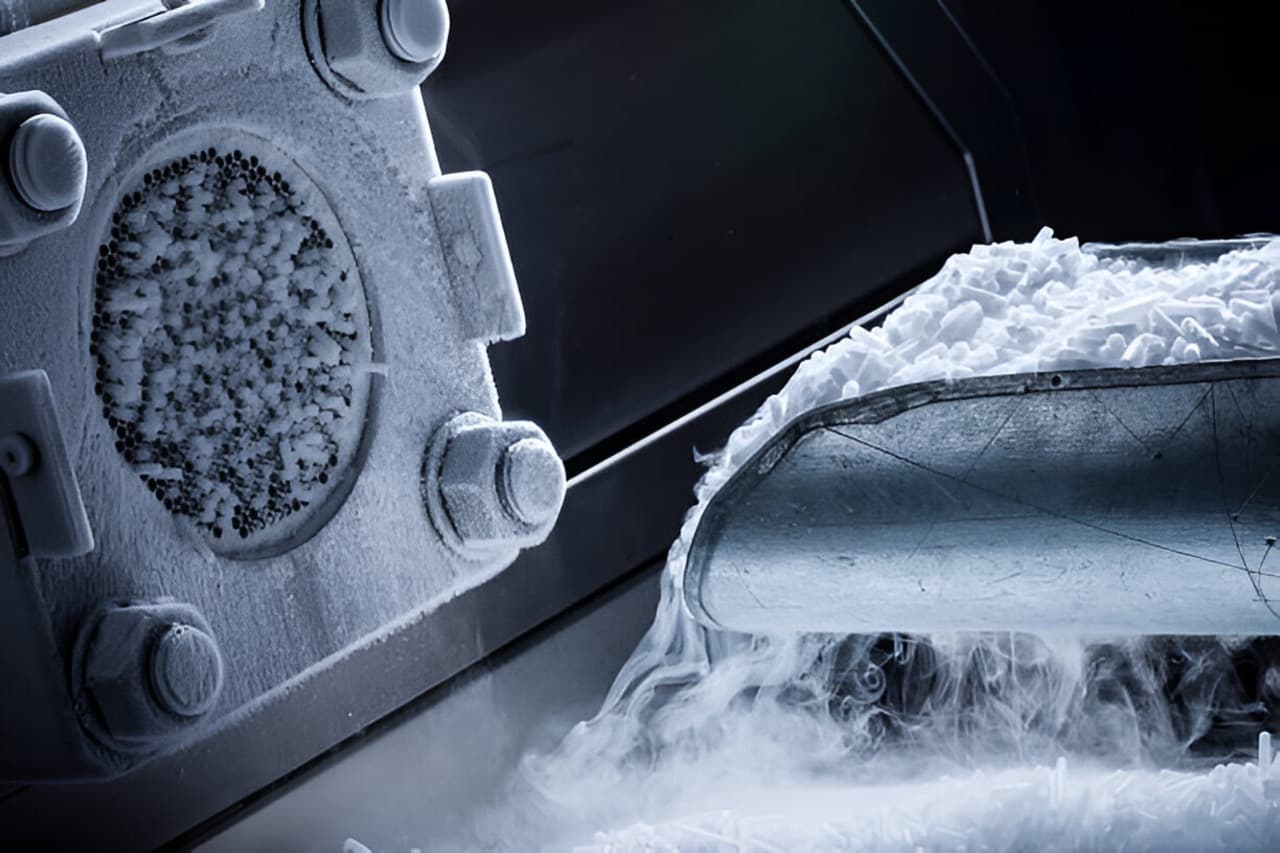
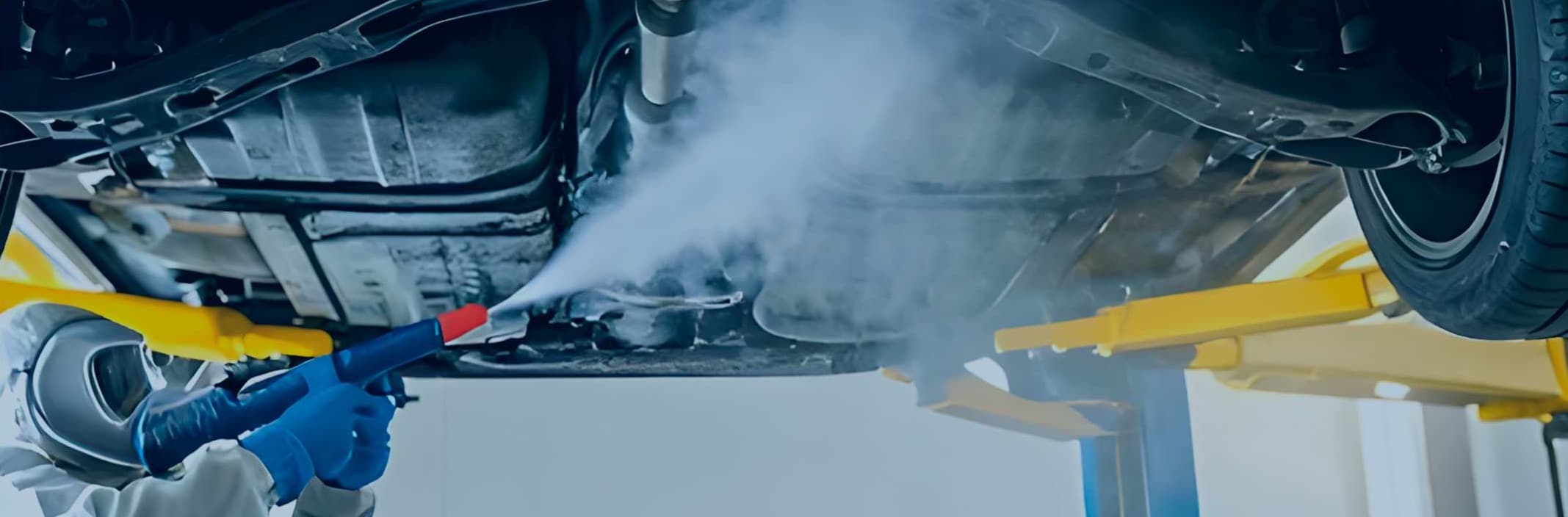
Dry ice is solid carbon dioxide at minus 78 degrees. Pellets hit the soil, the cold makes it brittle, the pellet turns to gas on impact and lifts the soil off. Nothing is left on the surface but the loosened soil, which gets vacuumed or swept out of the area. There is no dilution to record, no contact time, no rinse verification. The residue line in your record reads "not applicable" and an auditor will accept that because it is physically true.
One honest caveat. Dry ice does not sanitize. It removes soil. Your kill step, whether that is a quat spray, a peracetic acid rinse or hot water, still follows. The difference is that your sanitizer now lands on bare stainless instead of a film of half-removed grease, and one light sanitizer pass is a lot easier to rinse and verify than a full caustic foam cycle.
Water is the other problem
Chemical cleaning is wet cleaning. Foam, scrub, rinse, rinse again. That water goes into hollow rollers, motor housings, the gap between a frame and its stitch weld, floor drains, and the cracks in a twenty-year-old epoxy floor in a Delta plant that never quite dried out since 2009.
Listeria monocytogenes lives in exactly those places. Anyone who has chased a persistent environmental positive in a Lower Mainland seafood or deli plant knows the pattern: swab, clean, swab, positive again. The niche is wet, cold and protected. Chemical cleaning keeps feeding it water.
Dry ice adds nothing. The CO2 gas leaves the room through your ventilation. The frame is dry when we finish, and dry is the state in which Listeria stops growing. That single property is why dry ice blasting shows up in corrective action plans for ready-to-eat lines after a positive, and why some plants keep it on a quarterly schedule afterward instead of going back to foam.
There is a drain side too. Caustic and acid rinse water leaving a Burnaby or Richmond plant has to land inside the pH window in Metro Vancouver’s sewer use bylaw. Larger plants neutralize. Smaller ones sometimes do not, and the bylaw inspector is a different visitor from the food auditor.
Where chemical cleaning still wins
I am not going to tell a brewery to dry ice blast the inside of a fermenter. Clean-in-place circuits, tanks, pipe runs and anything sealed are chemical territory and always will be. Caustic, acid, rinse, sanitize, on a loop, with the flow rates logged. That system works because the equipment was designed for it.
Chemical foam also still makes sense on wide open floors and walls with light daily soil where a two-person crew with a foamer can cover 400 square metres in an hour. Dry ice is slower per square metre on light soil and costs more per hour. Using it for a routine wipe-down is the wrong tool.
The case for dry ice is the equipment that chemical cleaning handles badly: baked-on and carbonized product, anything with electrical components, anything that takes a day to disassemble, and any surface where the water itself is the hazard.
The downtime math on a Burnaby line
Take a snack line in Burnaby running finished product worth about $3,000 an hour. The fryer hood, exhaust plenum and exit conveyor need a deep clean because the carbonized oil has built up past what the nightly wash reaches.
Chemical deep clean, the way it actually happens: two hours to cool the fryer to the point where staff can foam it, four hours of foam, dwell, scrub and re-foam, ninety minutes of rinse, two hours air drying before anyone will sign off on the electrical, then sanitize and swab. Ten hours. Thirty thousand dollars of product not made, plus three people on overtime, plus about $600 in chemical.
Dry ice on the same equipment: one hour partial cool-down because we can work on a warm surface, three and a half hours of blasting with a second tech on containment and vacuum, half an hour to sanitize and swab. Five hours. The invoice for that job sits around $4,500.
The plant saved fifteen thousand in production and paid a bit over four thousand for the service. That is the number the operations director signs off on. The QA manager signs off on the dry hood and the swab result.
Not every job produces that spread. Run your own hourly figure against the gap, not against our invoice.
What dry ice cleaning costs in BC, and why quotes swing
Across Greater Vancouver a contracted dry ice blasting job on food equipment lands between $1,500 and $8,000 CAD. Most single-shift plant jobs come in from $2,800 to $6,500 including the dry ice, the crew, containment and the vacuum recovery of the soil.
What pushes the number to either end:
- Soil type. Carbonized sugar on an oven band takes twice as long as fresh grease on a packaging frame.
- Access. Equipment we can walk up to versus an exhaust plenum that needs a lift and a confined-space plan.
- Shift timing. Night and weekend windows, which is when most BC food plants want the work, carry a 15 to 25 percent premium.
- Dry ice logistics. Pellets sublimate in the tote. A crew burns 250 to 500 kilograms in a shift and the supplier delivers fresh the morning of the job. A remote site outside the Lower Mainland adds a delivery charge and a loss allowance.
Chemical deep cleaning by an outside crew runs $1,200 to $5,000 for a comparable scope. Cheaper on paper. Add the extra downtime hours, the rinse water, the drying time and the second rinse when the pH strip fails, and the gap closes fast on anything heavy.
Safety on the day: CO2, noise, lockout
Dry ice work carries its own hazards and a QA manager should ask about all of them before signing the contractor in.
Carbon dioxide displaces oxygen. WorkSafeBC’s exposure limit for CO2 is 5,000 ppm over an eight-hour shift. In a large production hall with normal air handling that is never an issue. In a cooler, a smokehouse or a walk-in oven with the fans off, it is. We bring a CO2 monitor into any enclosed space and we run supplementary ventilation before the first pellet leaves the nozzle. Ask your contractor whether they own a meter. If the answer is a pause, keep looking.
Noise sits between 100 and 115 decibels at the nozzle. Hearing protection for the crew is mandatory and anyone within about ten metres needs it too, which usually means the area is cleared of plant staff while we run.
Lockout and tagout applies the same way it would for any maintenance task. We are working around motors, belts and drive chains. We do not blast live equipment, and we ask for the plant’s lockout procedure the week before, not the morning of.
No silica, no abrasive dust, no chemical splash, no slip hazard from wet floors. Those are four lines of a WorkSafeBC risk assessment that disappear when the method changes, and that matters on the day and on your insurer’s renewal form.
Three Lower Mainland jobs
A sauce plant in Delta’s Tilbury industrial area. Continuous oven with a stainless mesh band, three years of carbonized sugar and tomato solids. Chemical had been tried twice, and the caustic dwell time was long enough that the band came out clean and the roller bearings came out ruined. We blasted the band in place over one Saturday night shift, about seven hours including containment. No disassembly, bearings untouched, and their QA ran ATP swabs on Monday morning that passed on the first attempt. Invoice was just under $6,000.
A seafood processor in Richmond. Persistent Listeria environmental positives on a hollow-frame conveyor over four months. Their sanitation crew had been foaming it to death. We dry ice blasted the frame, the leg bases and the drain surround, then their team applied sanitizer to a dry surface. The next three swab rounds came back negative. That job was about $3,200 and took a single shift.
A bakery packaging line in Burnaby. Flour dust and oil film on a flow-wrapper with a control panel on the side. The plant did not want water anywhere near the electronics and did not want two days of disassembly either. Four hours of dry ice at low pressure with the panel doors closed and taped. That one ran $2,400.
The paperwork we hand over
Dry ice fails audits when the record is missing, not when the cleaning is. So we hand your QA manager a package they can drop straight into the preventive control plan: the written scope with the equipment list, pre and post photos with timestamps, the pellet size and pressure used, the containment and vacuum method for the removed soil, the CO2 monitoring readings for any enclosed space, the crew’s safety documentation, and the SDS for carbon dioxide because an auditor will ask for it even though it is the same gas in your soda fountain.
If your plant swabs after cleaning, and it should, those results go in your file next to our sheet. That is the verification step. It is the same swab you already do after chemical.
My recommendation
Keep chemical cleaning for CIP circuits, tanks, closed systems and light daily soil on open surfaces. It is the right tool there and no one serious is arguing otherwise.
Move to dry ice blasting for the heavy jobs: carbonized product on ovens, fryers and bands, hollow-frame conveyors with a Listeria history, anything with electrical components, and any piece of equipment where the disassembly and drying time cost more than the cleaning. Follow it with a light sanitizer pass on the dry surface and swab as usual.
That split gives you a cleaner audit file, drier equipment and shorter shutdown windows. The Greater Vancouver plants that made the switch on their problem equipment have not gone back to foam.
We have been running industrial cleaning across BC for over a decade. Fully insured, WorkSafeBC compliant, CBRB Best Cleaning Services in BC 2025. If you want a dry ice scope for a specific line, request a quote with the equipment type and your next shutdown window, or read how our dry ice blasting service fits a food plant schedule. A site walk in the Lower Mainland is free and usually takes under an hour.